


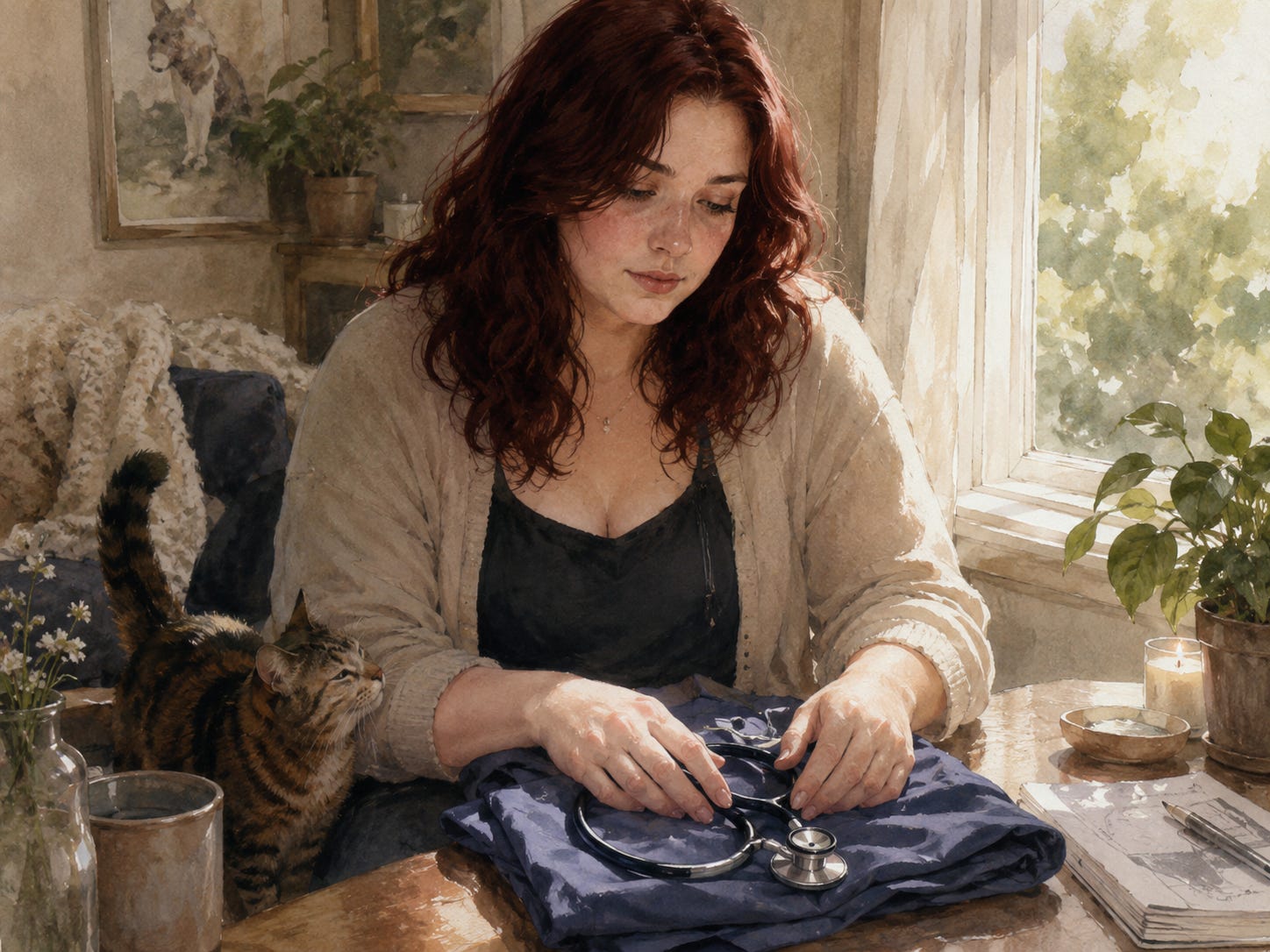
My hands have been away from veterinary medicine longer than they know how to understand.
Sometimes I wonder what they have forgotten.
I wonder whether they would still move with the same certainty in an emergency, whether they would remember the familiar weight of a syringe or the precise amount of pressure needed to hold a frightened animal without making its fear worse. I wonder whether they could still find a vein beneath fur, tape a catheter securely, draw up medication without hesitation, or recognize the subtle shift in a patient’s body that says something is wrong before a monitor ever begins to alarm.
It has been long enough for doubt to settle into the spaces where instinct once lived.
Then one of my cats coughs strangely, limps across the room, refuses a meal, or holds himself in a way that feels just slightly off—and something inside me wakes up.
My eyes begin assessing before I have decided to assess. My fingers move through fur, checking for heat, swelling, tension, tenderness. I watch the rise and fall of a rib cage. I notice the color of gums, the focus of eyes, the placement of paws. I listen to what the animal cannot tell me in words.
My hands remember.
That is the strange thing about leaving a profession that became part of your body. You may stop clocking in. You may pack away your scrubs and stethoscope. Months may pass without the fluorescent lights, the ringing phones, the barking dogs, or the antiseptic smell clinging stubbornly to your clothes.
But some part of you remains on call.
I did not leave veterinary medicine because I stopped loving it.
I left because the place where I practiced it stopped feeling safe.
There is a particular kind of devastation in being wounded inside the work you once considered home. It complicates everything. The job itself becomes tangled with the people who harmed you, the rooms where you learned to brace yourself, and the conversations you replayed long after you had gone home.
Eventually, your body stops understanding the difference between the work and the danger surrounding it.
A clinic phone is no longer simply a phone. A closed office door is no longer simply a door. A manager asking to speak with you can make your stomach drop before a single word has been said. Even ordinary mistakes begin to feel catastrophic when you have spent enough time believing that any imperfection can be used against you.
You learn to anticipate punishment.
You learn to make yourself smaller.
You learn to apologize before anyone has accused you of anything.
And then, one day, you leave.
People sometimes imagine leaving a toxic workplace as a clean escape. You walk out, the harm ends, and your life begins again.
I wish trauma were that courteous.
Sometimes leaving is only the moment when your body finally has enough silence to tell you what happened.
For a long time, I wanted to return to veterinary medicine. I missed it with an ache that was difficult to explain. I missed the patients. I missed the strange intimacy of being trusted with a living creature at its most vulnerable. I missed the satisfaction of solving a problem, easing pain, calming fear, and helping someone understand what their animal needed.
I missed being useful in the particular way veterinary medicine taught me to be useful.
Yet whenever I tried to move toward it again, fear seemed to arrive before I did.
I went to an interview at a clinic that felt too much like somewhere I had already survived. There was nothing I could immediately point to and name as wrong. It was more instinctive than that. A familiar atmosphere. A resemblance my nervous system recognized before my mind had found the language for it.
I knew I could not work there.
Other times, I could not even make it through the door.
I would prepare for an interview, tell myself that this was what I wanted, and feel panic begin to climb through my body. My heart would race. My thoughts would narrow. The part of me that had spent years functioning through emergencies could no longer convince my own nervous system that I was safe enough to attend a conversation.
It was humiliating.
At least, that is what I called it then.
I thought my inability to go meant I was weak. I thought it proved that I had lost something essential. I worried that every month away was creating more distance between me and the technician I had once been.
I wanted to go back so badly.
Why couldn’t I just go?
That question followed me for a long time, carrying far more cruelty than curiosity.
I understand it differently now.
There was never a lack of desire. The fear did not exist because I no longer cared about the work. It existed because I cared so deeply, and because something I loved had become inseparable from something that hurt me.
My mind remembered the animals.
My body remembered the danger.
Both were trying to protect me, though in very different ways.
The part of me longing to return was protecting my identity, my purpose, and a career I had spent years building. The part of me panicking was protecting the person who had once endured more than she should have had to endure.
Neither part was my enemy.
They were simply pulling in opposite directions.
Veterinary medicine taught my hands how to care for frightened animals. It taught me that fear is not stubbornness, defiance, or bad behavior.
Fear is communication.
A growl is communication.
A frozen body is communication.
A cat pressed into the farthest corner of a carrier is not giving anyone a difficult time. That animal is having a difficult time.
I have always believed frightened patients deserve patience. They deserve gentleness, time, and the chance to feel some measure of control. They deserve to be approached as living beings whose fear makes sense, even when we cannot see every experience that created it.
It has taken me much longer to offer myself the same understanding.
I would never look at a terrified animal and demand that it simply try harder to feel safe. I would never shame it for needing distance, for hesitating at the door, or for remembering the last hands that caused pain.
Yet I have asked those things of myself repeatedly.
I have treated my own fear as a character flaw instead of a response.
Tomorrow, I have another interview.
Even writing that sentence stirs something inside me. Hope, certainly. Fear, too. They have learned to arrive together.
I do not know whether this clinic will be right for me, whether an offer will come, or whether I would accept one. I do not know what my body will remember when I walk inside and smell that familiar combination of disinfectant, fur, and medicine.
I do know that I want to try.
Not because the fear has vanished.
It has not.
I am trying because I am beginning to believe that fear does not always mean stop. Sometimes it means move carefully. Pay attention. Ask questions. Notice how people speak to one another when they believe no one important is listening.
This interview is not only a chance for a clinic to decide whether I am good enough for them.
It is a chance for me to decide whether they are safe enough for me.
That distinction matters.
For most of my career, I believed my job was to prove myself through speed, knowledge, resilience, and usefulness. I learned to tolerate long hours, impossible expectations, emotional whiplash, and constant pressure without becoming inconveniently human.
I no longer want to prove that I can endure anything.
I already know that I can.
What I want now is a place where endurance is not the primary condition of employment. I want to work somewhere compassion is not reserved exclusively for the patients. I want to believe there are clinics where mistakes become conversations instead of weapons, where questions are treated as responsibility rather than incompetence, and where the people caring for animals are allowed to be people themselves.
Perhaps tomorrow I will find that.
Perhaps I will not.
The uncertainty is uncomfortable, but it is also honest.
This is not a triumphant story about overcoming trauma. There is no perfect ending yet. I have not returned to veterinary medicine, reclaimed every part of myself, or proven that fear no longer has power over me.
I am still afraid.
I still want it.
For now, that is where the story lives—in the space between those two truths.
Maybe courage is not the absence of panic. Maybe it is not walking confidently through a door without once remembering the last room that trapped you.
Maybe courage is allowing yourself to approach the door again while carrying every reason you once ran from it.
I do not know how much my hands have forgotten during this time away.
Skills need refreshing. Medicine changes. Confidence can become rusty when it has been left untouched for too long. There may be moments when I hesitate over something that was once automatic. I may need help. I may need patience. I may need to learn how to trust my own judgment again.
But I also know what remains.
My hands remember how to soften when an animal is afraid.
They remember that restraint should never be about overpowering the patient, but about keeping everyone safe with as little added fear as possible. They remember how fragile life can feel beneath fur and how enormous the responsibility is when someone places that life into your care.
They remember the patients who leaned into me.
They remember the ones who fought because fighting was the only language they had left.
They remember the animals I could help, the ones I could only comfort, and the ones whose absence followed me home.
Most of all, they remember that this work was never merely a job.
It was a way of paying attention.
It was a way of loving creatures who could not explain where it hurt.
It was a way of standing beside people during some of the most frightening and heartbreaking moments of their lives and saying, in whatever small way I could, that they did not have to face those moments alone.
The people who hurt me took many things.
They took my sense of safety. They damaged my confidence. They made me question whether there was still a place for me in a profession I had devoted so much of myself to.
But they did not take everything.
They did not take my tenderness.
They did not take my knowledge.
They did not take the part of me that notices when an animal is trying to speak.
Tomorrow, I will walk toward a veterinary clinic again.
I cannot promise that I will feel fearless when I reach the door.
But I think my hands will remember what to do.
And perhaps, eventually, the rest of me will remember too.